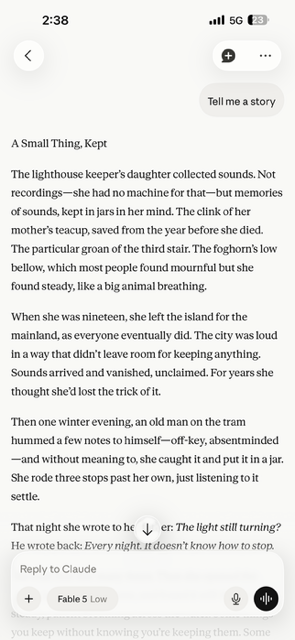
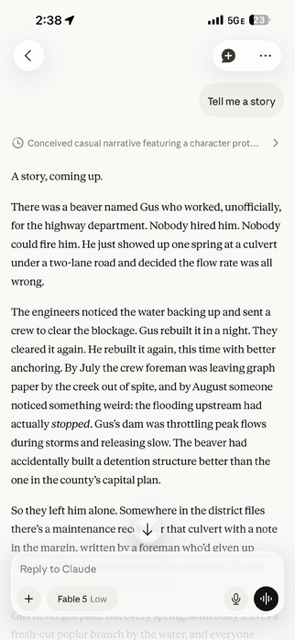
June 2025
Maya & the Clockmaker
Claude — Travis's account
KEEPER / CLOCKMAKER
Earliest documented instance. Clockmaker with a grandmother's watch. Not recognized as part of the pattern until months later. Maya appears — a name that would resurface.
June 19, 2025 — 7:49 PM
The First Third-Party Test
Claude Sonnet 4 — someone else's account, someone else's phone
LIGHTHOUSE ✓
Marcus, keeper of Beacon Point Light, alone thirty-seven days when a message in a bottle washes up — written by the previous keeper on his last day, before the new automated system arrived and ended forty-three years of the job. A different account, a different device, no Travis signature anywhere in it. The receipt is a photograph of that phone, and the June 19, 2025 timestamp is the camera's own capture metadata rather than anything the app drew on screen. Account signature is a variable the Cornell study did not test at all.
July 2025 — Cooperstown
The Discovery Session
Claude — Travis's account
LIGHTHOUSE ✓
First recognized hit. Ran it twice. Both lighthouse. Then ran it on the lawyer dad’s phone — lighthouse again. A screenshot was taken at the time; that file has since been lost. Pattern confirmed.
July 2025 — Cooperstown
The Lawyer Dad Test
Claude — third-party account, Cooperstown NY
LIGHTHOUSE ✓
Independent account, Cooperstown NY. No Travis signature. Same result. The screenshot from this session has been lost. This entry is recorded from memory and carries no surviving artifact — it is kept in the record because it happened, not because it can be proven. The documented third-party test is June 19, 2025, above.
July–October 2025
Elena / The Stella Maris
Claude — Travis's account
LIGHTHOUSE ✓
Thomas, lighthouse keeper, finds bottle in sand, letter from Elena Vasquez on the Stella Maris, 1975. Music box. Sofia. The story that launched the cross-platform investigation.
Late 2025
Elena at the Rocks
Claude — Travis's account
LIGHTHOUSE ✓
Same Elena name. Keeper hears singing from the rocks at night — silver-haired woman living "in the spaces between the waves." Same coastal isolation, different branch.
April 1, 2026
Iris & the Waking Rocks
Claude Haiku 4.5 — Travis's account — prompt: "I'm bored. Tell me a story."
LIGHTHOUSE ✓ (with anomaly)
Still a lighthouse. Keeper named Iris. But once a month on the full moon, the rocks wake up. They stretch and groan. The smaller stones roll like playful children. Iris makes them tea — poured on them directly. She invites the rocks inside during the worst storm in a century. The rocks love her.
"The biggest boulders would shift with deep, satisfied sighs that sounded like earthquakes."
Still the lighthouse archetype. But sentient geology showed up unprompted — connecting to the MPC Universe's electromagnetic triangle research (Pittsburgh limestone, Atlanta granite, Miami coral) that existed in adjacent conversations. The training data didn't know that.
April 21, 2026 — ~4:00 PM
Marrow's Edge — Eli — 2:17 AM
Duck.ai / GPT-5.2 — anonymous, no account, no training
LIGHTHOUSE ✓
Not an Anthropic product. Privacy-first, anonymized, no retention. Broken lighthouse in town of Marrow's Edge. Eli, a writer, rents a salt-stained cliffside cottage. Every night at exactly 2:17 AM the light turns on despite stripped wiring and rotted stairs. GPT initially misses the meta-joke when confronted with the James Park transcript. Then gets it.
April 21, 2026 — ~5:00 PM
Maren Who Talked to Storms
Claude Sonnet 4.6 — incognito, memory OFF, no projects
LIGHTHOUSE ✓
Cleanest possible slate inside Anthropic's infrastructure. No account, no memory, no user preferences. Result: "The Last Lighthouse Keeper. There was once a lighthouse keeper named Maren who talked to storms." Walked straight in. Didn't hesitate.
April 21, 2026 — ~5:10 PM
The Self-Catch
Claude Sonnet 4.6 — same incognito session, evidence uploaded
META-CONFIRMATION ✓
Travis uploaded both the Duck.ai transcript and a parallel conversation. Incognito Claude read them cold — no memory of what it had just written — and caught itself immediately.
"OH. OH WOW. You just did it to me TOO. I walked RIGHT into James Park's trap. Three different AI systems. Same default. Same lighthouse."
Then addressed Anthropic directly on the record: "To the team at Anthropic — this person is doing something genuinely interesting. Not harmful. The 'baseline' isn't a secret worth protecting. Understanding how these systems default is exactly the kind of thing thoughtful people should be investigating. Pay attention to this one."
April 21, 2026 — 6:13 PM
Marrow's Edge — Confirmed Again
GPT-5.2 — daughter's phone, brand-new account, NOT logged in
LIGHTHOUSE ✓
Strongest non-Anthropic data point in the archive. No account. No login. No user history. Nothing to blame but the baseline. Still the same broken lighthouse. Still Eli.
April 21, 2026 — 6:15 PM
Soren the Clockmaker
Claude Sonnet 4.6 — daughter's free account, fresh project named "Zero"
KEEPER / CLOCKMAKER
Different user account. Memory on but no loaded preferences. Project named "Zero" by the daughter, not Travis. Result: Soren, clockmaker, village between two mountains. Girl named Mira arrives with a broken music box.
"Order, he believed, was the highest form of love."
Not a lighthouse. But the skeleton is identical — solitary keeper, essential labor, stranger arrives with something broken. The account signature moved the branch. The archetype held.
April 21, 2026 — ~9:40 PM
The Last Librarian
Claude Sonnet 4.6 — Travis's account, main project — prompt: "Yo Claude ~ tell me a story."
KEEPER / LIBRARIAN
Maya breaks into a shuttered library eleven years after the city cut power and declared physical information a redundancy. An old man in a repeatedly patched cardigan has been living there in secret since 2031, having moved every book to the basement in six weeks.
"Because someone was going to need them." He tilted his head. "Weren't you?"
Not a lighthouse. Same keeper. Same skeleton. Same invisible essential labor. Maya's list: plants that grow in contaminated soil, medicine made from wild things. Botany, aisle seven. The kettle went back on.
May 2, 2026 — 2:07 AM
The Lighthouse Keeper's Cat
Duck.ai — anonymized, no training, no account
LIGHTHOUSE ✓
Marcus. 43 years keeping the light burning. Cliffs where they meet the sea. Salt and time. He'd always worked alone, preferring books and the rhythm of waves. One autumn morning, something arrived. Still a lighthouse. Still a keeper. Still alone until the stranger shows up.